The Math does not Math: When GDP, income and property follow a power law, the vast majority of the population – 80% and more – will always be “below average”.
The Globe and Mail ran an article on February 20, 2026, “Out of Nowhere, Canada Became Poorer than Alabama. How is that possible?” citing figures from an IMF study by Canadian economist Trevor Tombe, which found that in 2024, Canada’s GDP per-capita was lower than Alabama’s.
There’s lots wrong with the piece: if you are looking for lessons on what Canada could do differently, you won’t get them.
First, per capita GDP is not just a bad indicator, it is not valid mathematically: the distribution of income follows a power law where wealth and income go up exponentially the more concentrated they get. Trying to take an average of such a curve always generates inaccurate answers. Since the entire article is built on that premise, that is a problem.
Second, comparing GDP in two different currencies depends on “purchasing power parity” – which is the relative strength of two currencies, which means that is varies with the US-Canada exchange rate. The Canadian dollar is now tightly correlated with the price of oil – which is a global price. When oil is high, the Canadian dollar is high and vice versa.
That means that if the price of oil goes up, and the Canada-US exchange rate changes – and the Canadian dollar goes up in value, from 70 to 75 US cents, it makes US dollars cheaper for Canadians – from $1.43 to $1.33. (The curve of the exchange rate relationship is a hyperbolic decay curve.)
If this happens, it changes the purchasing power parity for both countries. This was the basis of the grossly inaccurate articles about Canada having the “richest middle class in the world” after the U.S. financial crisis. Canada had, in fact, massively bailed out its banks, but the big reason was that the Canadian dollar was so high relative to the U.S. dollar, because the price of oil was high.
That is part of the third problem: which is that the rest of the way both the Canadian and US economies which miss some large scale factors and historic events that were so huge that they can’t be left aside. It’s a selective account of both Alabama and Canada’s economies that loses critical context. For example, Canadian governments during crises have often more austere than the U.S. Government.
Finally, there is the economic context, which that the U.S. and Canada are each at what is likely the highest concentration of wealth in history: in the U.S. the top 20% of the population own 80% of the property, while in Canada, the top 20% own 70%.
This last is important, because the real distribution of wealth and income in the economy matters: who actually has money, who has income, who owns property.
The real world distribution of these is a power law curve, which delivers a radically different distribution than a bell curve, or a gradual upward linear slope.
It is a curve that slopes up gently for the vast majority of the population, then takes a sharp turn upward, like a hockey stick, and income and ownership start to increase exponentially.
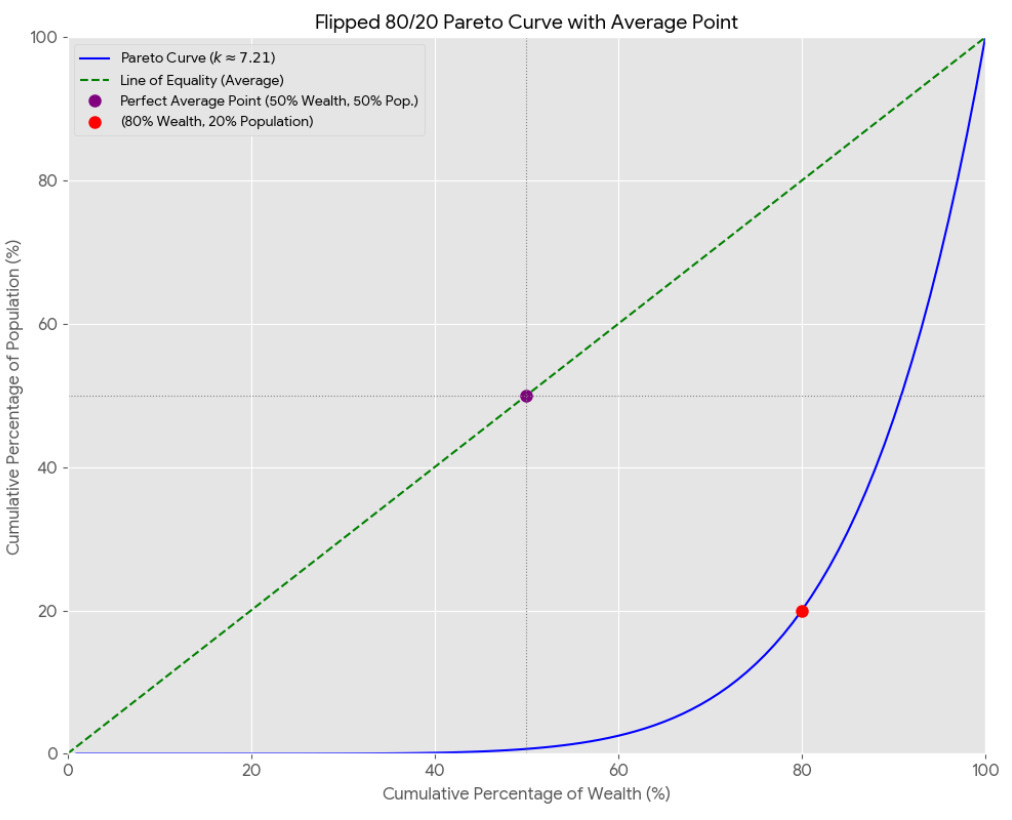
In an 80:20 curve like this one, 86.5% of the population would be below average. Only 13.5% of the population is “above average.”
In the chart below, all of the relevant numbers on the curve are below the blue line, but the average is in the middle of the chart – far away from the actual distribution.
In a 70:20 curve, as in Canada’s, the percentage of the population that is below average is 84.9%. Only 15.1% are “above average.”
It’s not just for the whole curve: it’s for any part of it. A power law curve is fractal, or scale-invariant: that means splitting the distribution into quintiles, or deciles or any other sub-group that also relies on averaging or per capita will also be inaccurate.
For the three lower quintiles the average is closer to the median – with 52% of the group being below average, but by the time it gets to the top quintile, 83% are below average.
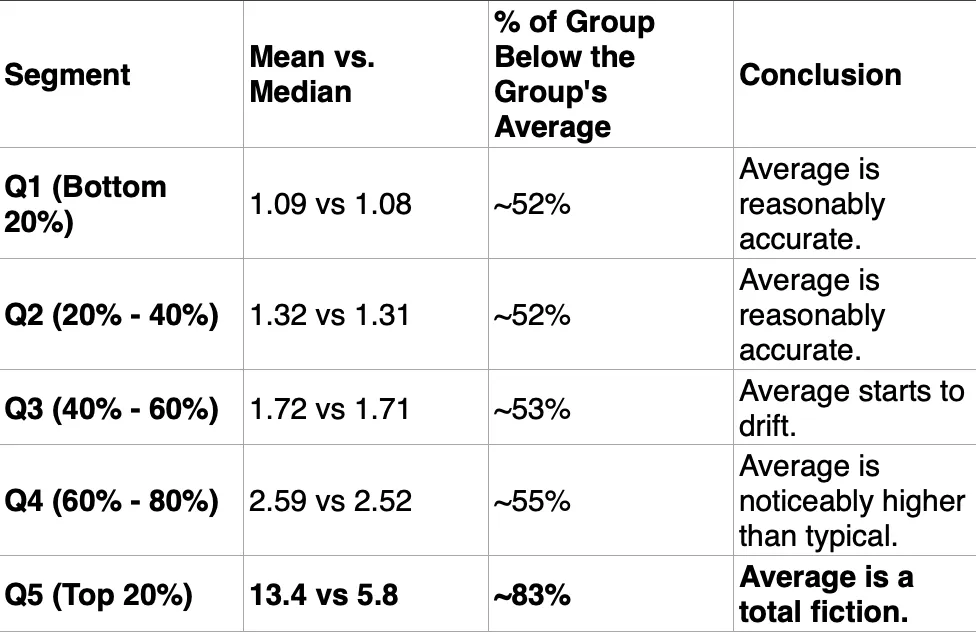
This is why “per capita” GDP is meaningless, and using it, or averages should be considered a fallacy when it comes to power law distributions.
When we have had 50 years of improvements in information gathering and processing techniques, the formulas and much of the data of economics are still mired in a pre-electronic era.
This extreme concentration of wealth and ownership in the hands of a few, while so many are going without, is because we are not just in a recession, but because we are in a massive debt-fuelled asset-bubble in real estate and stocks.
Looking at the Details: Alabama V Canada
We have the capacity to see, in much greater granular detail, the major structures of ownership – and the hyperconcentration of wealth.
In many ways, the Globe piece is trafficking in stereotypes, not just about Alabama, but about Canada. There’s an implication that Canada’s higher levels of unionization are somehow holding the country back.
There are some other salient points about Alabama, some of which defy stereotypes about it being a place of profound and brutal racial bigotry and ignorance, and some that confirm it.
Huntsville, Alabama, has been a centre for rocket science and manufacture since the 1960s, so the concentration of individuals who were among the best minds is not surprising, although the fact that the local civic centre is named after Nazi rocket scientist Werner von Braun might be.
Alabama is on the Gulf of Mexico and has 30 oil refineries, at least one of which refines Canadian crude – which it can buy at a $10 barrel discount compared to the world market.
Part of the premise of the Globe and Mail article is that Alabama’s success in attracting car manufacturers or Eli Lilly is that manufacturing can be equated with good jobs, when Alabama’s entire strategy is to undercut other jurisdictions by offering corporations access to a workforce who can be exploited and whose wages and benefits are the same, in real 2024 dollars, that a GM worker would have made in the 1970s.
This is not an exaggeration: in 2024, Alabama prison labour’s $7.25/hr wages are garnished by 40%, leaving the worker with $4.35 an hour. In 1970, GM workers won a pay increase to $4 an hour, which, with benefits was $6 – half a century ago.
Alabama’s prison system effectively enslaves thousands inmates, who work at everything from fast food to “major car-part manufacturers and meat-processing plants to distribution centers for major retailers,” where their wage garnishment alone has generated “more than $250 million” for the state government.
In December, 2024 – the year the Globe article compares Alabama with Canada NPR in the U.S. reported on the prevalence, exploitation and abuse of prisoners who are forced to work, and who have no worker protections whatsoever. As Amanda Nelson, a U.S. political commentator has emphasized, the U.S. never banned slavery entirely: it is still effectively legal in some States to treat prisoners as slaves, and they do. From 2019 to 2024, “more than 500 companies have been essentially leasing out incarcerated workers from the state.”
… oftentimes when incarcerated workers are hurt or killed on the job, it’s very difficult for them. There’s a dual system. They don’t have the same rights and protections that other American workers have. So they might not be eligible for things like workers’ compensation, disability benefits. They can’t protest or strike if they have poor working conditions. And if they refuse to work, in some cases, they can be punished.
In one instance, a man was fired from his job working 40 hours a week at KFC, because he asked for a raise, and was then denied parole.
“He said that there were teenagers working the counter, you know, on weekends that were making more than him. And so then when he came up for parole, he said that he was denied and that that was used against him – the fact that he was fired.”
And even though these are – these jobs are voluntary, they’re also coveted because the system is so violent that most of the workers want to work in these programs that are attached to these minimum-security facilities. And if they refuse to work, they could then be sent back to the more violent facilities. I think Alabama last year, almost one person died every day.”
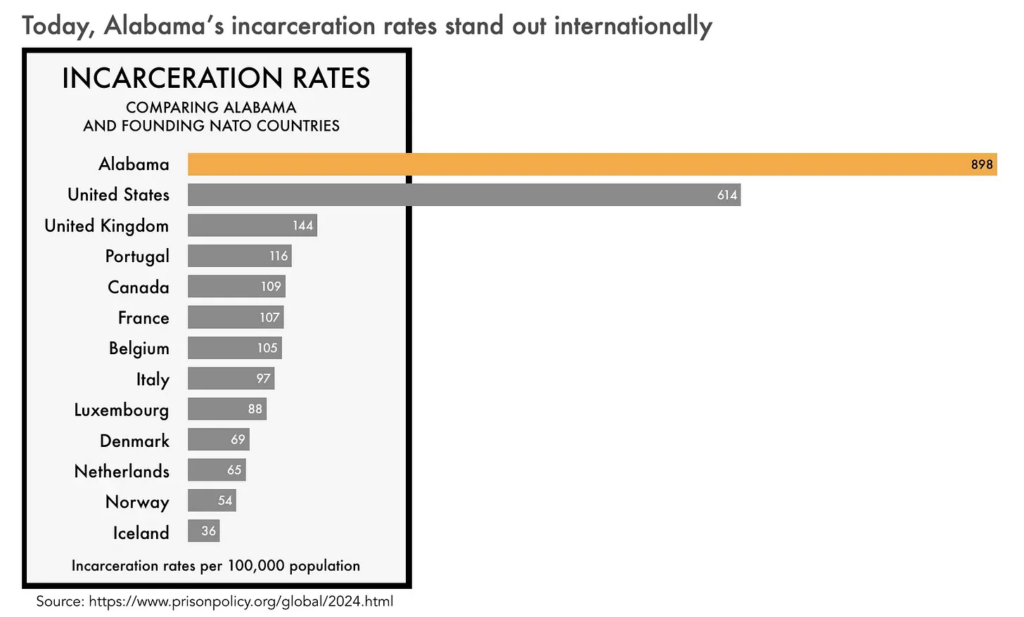
At 898 out of every 100,000 residents, Alabama’s 2024 incarceration rate was the highest in the U.S., and the U.S. incarceration rate is the highest in the world. And yes, most of the inmates are Black.
“Big Government” in the US and Canada: A Tale of Two Myths
Canada’s current economic and political situation cannot be understood without recognizing the massive economic shocks the U.S. and especially Canada have experienced that have created greater and greater precarity and private debt in Canada.
First, an oil boom in the 2000s and 2010s. With the price of oil over $100 a barrel, the Alberta economy was growing faster than China, and other oil producing regions were also booming. The high oil price drove up the Canadian dollar, which made imports cheaper and exports more expensive. It resulted in the loss of hundreds of thousands of manufacturing jobs, in Ontario.
People started to believe – as they are wont to do – that ultrahigh oil prices were the new normal. The oil industry’s gains were outstripping the losses elsewhere in Canada. The idea was that, if Canada was going to become an energy superpower, it just reflected a change or evolution for the economy.
Albertans had forgotten their solemn bumper sticker prayer of the 1980s – “Lord, send me another oil boom – I promise I won’t piss it away like the last one.”
In fact, the same thing happened to that had happened in the 1980s: Saudi Arabia and OPEC pulled the rug out from under the global oil market.
In 2014, the decision by Saudi-Arabia to start a price war, which crashed the price of oil by 70% in two years, is one of the three most important events to impact Canada in the last 25 years, the other two being the Global Financial Crisis and the Pandemic. Investments ceased, there were immediate layoffs, bankruptcies, housing prices dropped, it affected federal transfer payments. Once Trump was elected, he also sought to lower prices for political reasons, which drove a second shock wave in 2018-19.
This was deliberate financial warfare, in the same year that Russia invaded Ukraine and seized Crimea.
The 2014 Saudi/OPEC Oil Shock should be at the centre of every discussion on oil and gas in Canada. It was a declaration of financial warfare, aimed at North America and its shale industry. It beggars belief that an event of historic significance, which has done more to shape politics, the economy and popular discontent across Canada than any other in decades, is completely ignored.
Every Political Party in Canada is Economically Conservative
Another one of the stereotypes about Canadian vs US economies is that Canada has much more “big government” compared to the U.S., when Canada, like the US has been enacting Reaganomics and Thatcher-type policies for decades.
This is really all based on political propaganda: the U.S. government plays a colossal role in the U.S. economy, especially through defense spending, and the Canadian Federal Government under the Harper Conservatives was the smallest it had been as a proportion of GDP since the 1930s.
There have been very substantial tax cuts, and austerity at the levels of both the Federal and Provincial Governments; almost every government in Canada, whether they are Liberal, Conservative, UCP, or NDP, are all neoliberal/ neoclassical in bent, and most are engaged in cuts and austerity, right now.
The entire premise of trickle-down, or supply side economics, is that you give more to the people who already have it, on the basis that they will use it to create more value, and Governments across Canada of every stripe have gone out of their way to add massively to public debt in a crisis to deliver unfunded tax cuts for the wealthiest individuals and largest corporations in society, just as Republicans and Democrats in the US and Labour and Conservatives in the UK have been doing.
Instead of fiscal measures, Canada – and the US and other developed countries – have relied extremely heavily on monetary policy, to spur on economic growth in a crisis – when the policy itself is putting out the fire with gasoline.
One clear example of how Canada was more conservative than the U.S. was in our response to the pandemic and its aftermath.
Canadian governments, including the Trudeau Liberals and the Bank of Canada were among the first governments to turn back to austerity, throttling back spending and investment while hiking interest rates. This decision was likely made on the terrible advice of now-disgraced economist Larry Summers, who warned that to control inflation, governments would have to drive up and maintain unemployment at 7%.
Compared to other countries who were running much larger stimulus, Canada’s economy has underperformed. The US, China and Japan all ran larger deficits as a % of GDP than Canada, and their growth was better as a consequence. An analysis by Claude, Anthropic’s AI, was that “Canada has run the tightest fiscal policy but has also seen the slowest growth of the four.”
This is not an accident: in Canada, despite all the bleating about “diversity being our strength” neoclassical economics has a stranglehold on government, political parties, policymakers and academe.
Harsh austerity also happened after the 2008 Global Financial Crisis.
The Canadian Government’s response to the 2008 crisis and the post-pandemic recovery was one of the smallest in history: monetary stimulus and fiscal austerity for provinces meant that instead of government investing in the economy, it was up to individual Canadians to take on more debt – for education, for health care, for housing. As in the U.S., the Canadian Government had a massive bailout of the financial system, except the Canadian bailout was not disclosed. A tepid stimulus package then harsh austerity.
This was also the case with Obama: though he was being described as a “socialist” by political opponents, Obama’s fiscal stimulus after 2008 was a lesser response than Reagan’s response to the recession of the early 1980s, even though the Global Financial Crisis was much worse.
Modern political parties have been convinced by the tales of Ronald Reagan as tax-cutter, when, in the 1980s, contrary to popular belief, Ronald Reagan poured money into stimulus, and reversed his own tax cuts with some of the highest tax increases in history, because they found the cuts didn’t work. Reagan won in 1984 because the price of oil dropped, and the federal government’s fiscal policies and the Fed’s monetary policies were all stimulating the economy.
By contrast, Obama’s policies were those of a “moderate republican”: “Obamacare” was a private market solution to the crisis in American health care that originated with a right-wing think tank.
What was required after 2008 was a New Deal of reinvestment and employment, and an investigation into the criminal, fraudulent and corrupt practices that led to a system so rotted out that it collapsed. Instead, not a single person was convicted criminally, and the patchwork of bailouts and dodgy loans became the foundation for more of the same, because of an overreliance on monetary policy to address the problem that has continued to make the rich richer while the poor get the picture.
Yes, Canada is in Crisis, and Imitating Alabama Will Not Help
For the last quarter century and more in Canada, instead of private investment going into productive industry, the policy of Canada’s cities, provinces, central bank, and federal government has been to get Canadians to take out personal debt to drive up housing prices, creating a personal debt and affordability crisis. (No mention of that, since that has been blamed on immigration, and not on money).
This is because, according to the economics that dominate Canada’s policymaking, there is no recognition of three fundamental, and basic accounting relationships in the economy between the public and the private sector, as an integrated and foundational aspect of the economy:
- Public sector deficits mean private sector surpluses
- Public sector debt is a private asset
- When the public sector reduces its debt, it is not a “saving” for the system, because it is shifted, on a 1:1 basis, to the private sector
In other words, everything that these policies do, and have done for 50 years in Canada and the U.S. has been to drive and accelerate the extreme concentration of wealth and ownership in the hands of a few.
The crises while so many are going without, is because we are not just in a recession, but because we are in a massive debt-fuelled asset-bubble in real estate and stocks, which is currently still only being held up by the AI bubble, which is likely to be burst by the Iran war.
What is required is for Canada and other countries to become, if not economic nationalists, then economic patriots.
It’s not just Trump’s tariffs that are collapsing the U.S. economy, it is his austerity and massive cuts, just as the Trudeau Government’s restraint made things worse, not better.
The superficial nature of political and economic commentary in the U.S. and Canada means that everything is based on “vibes” and personalities, not on economic data that clearly show that people are being driven by economic desperation.
The federal governments of the US and Canada both have the power to renew the economy.
It’s not that officials can’t – it’s that they won’t, because these nonsensical beliefs about the economy are so deeply ingrained. We are prisoners of our own ideas.